Thursday, February 6, 2020

User-specific XKB configuration - part 1

The xkeyboard-config project is the repository for all XKB descriptions, or "keyboard layouts" as the layman would say. But languages are weird and thus xkeyboard-config contains an obscene amount of different layouts. And of course there are additional layouts that are more experimental than common [1].

The fault, as usual, lies with us (the pronoun, not the layout). XKB is weird and its flexible to the point of driving even bananas bananas but due to some historic accidents it's largely non-editable. All XKB files are installed in system folders and we all know the 11th commandment was "thou shalt not edit things in /usr/share". But, luckily, that is all about to change. Or rather: it has changed as of libxkbcommon 0.10.0, released Jan 20 2020.

xkeyboard-config provides two types of files. The ones that actually set up your keyboard layout and the ones that allow you to keep sane while doing so, despite your best efforts to the contrary.

KcCGST

Let's look at the first set of files. XKB uses "keycodes, compat, geometry, symbols, types", conveniently if unpronouncably called KcCGST. Keycodes map your "physical" scancode to an internal code-name. For example, your key with the digit 1 on it is AE01 (alphabetic key, row E from bottom, key number 1 from left). Then you map those keycodes into symbols (1 and !). This happens based on the key's type which defines the combination of modifiers to produce the symbols [2]. Compat is largely magic weird stuff (locking modifiers, pointer control) and geometry would let you draw a pretty picture of your keyboard if it was defined for your keyboard which it won't be.

To see the full keyboard layout simply run xkbcomp -xkb $DISPLAY - and marvel. xkeyboard-config keeps all these parts so your X server or Wayland compositor can load it at runtime depending on your layout.

RMLVO

But when it comes to actual layout selection we like our users enough that we don't make them handle KcCGST but rather provide them with RMLVO instead - "rules, models, layouts, variants, options". You select layout "us" and something converts this into the right components to actually load. Run setxkbmap -layout us -print to see this happening.

"layouts" is what you'd usually associate with a country (except politics is still a thing, so more weirdness here) and "variants" are variations of those. Layout "us" gives you QWERTY and "fr" gives you AZERTY but the "us(dvorak)" variant gives you whatever heresy dvorak applies to those physical keys. And of course, things don't stop there - options are tack-on thingies that do stuff. Like remapping caps lock to compose so you're less capable of shouting at me. Come to think of it, it should really be enabled by default for that reason. You can combine multiple options largely at-will. "models" are largely obsolete (except where they aren't) thanks to the Linux kernel evdev interface which makes all keyboard look the same. But they used to be a thing and maybe one day they'll make a comeback like bell bottom jeans. Disliked by everyone but some weirdos insist on using them.

Rules

Finally, we have rules and thus come to the core of the matter of this post. Rules are magic files that tell the various tools how to go from RMLVO to KcCGST. It's a weird format but it's quite understandable, just open /usr/share/X11/xkb/rules/evdev and have a looksie. It'll make you the popular kid at the next frat party.

Many many moons ago before the Y2K bug was even in its larvae stage, the idea was that you could configure all of those because every UNIX tool had to be more flexible than your yoga teacher. I'm unsure to what extent this was actually ever the case but around 2007-ish the old keyboard driver got deprecated and the evdev driver made it's grand entrance. And one side-effect of that was that things broke. evdev uses different keycodes, so all those users that copy-pasted unnecessary XKB configuration into their xorg.conf now had broken keys because they were applying the wrong rules. After whacking enough moles that we got in trouble with the RSPCA we started hardcoding the "evdev" ruleset everywhere. The xorg.conf option "XKBRules" became a noop and thus stopped breaking users' setups.

Except that it also stopped users from deploying their own rules files - something that probably didn't really matter anyway. This had some unintended side-effects though. First, to have a working custom XKB layout you basically had to get it merged upstream. Yes, you could edit the files locally but they'd just be overwritten next time you update the packages. Second, getting rid of hardcoded things is hard so we're stuck with the evdev ruleset for the forseeable future. This was the situation until, well, now.

User-specific rules and layouts

The new libxkbcommon release changes two things: it prepends $XDG_CONFIG_HOME/xkb/ to the lookup path for XKB rules (and other files). So any file in that path will be picked before the system paths. This makes it possible to have KcCGST files in your home directory and actually use them. This was somewhat possible before by passing the right flags to the various tools but now it's on by default - at least where libxkbcommon is used (Wayland).

Secondly, rules files now support an include statement. This means you can set your own rules and include system rules. Because everything is hardcoded to evdev this effectively means your new rule file will be $XDG_CONFIG_HOME/xkb/rules/evdev and have at least one line: ! include %S/rules/evdev. If you do just that, you get the evdev ruleset from the system installation path. And any lines you add before or after that line will be loaded. Have a look at the git commit for the details but the summary is that you'll have a rules file that looks like this:

$ cat $XDG_CONFIG_DIR/xkb/rules/evdev
! option                =       symbols
  custom:foo            =       +custom(foo)
  custom:bar            =       +custom(baz)

! include %S/evdev
This file will define the option->symbol mappings as above and then include the system-provided evdev rules file, i.e. it'll behave like before with those two added. To get those to do something, you need to have the actual symbols files:
$ cat $XDG_CONFIG_HOME/xkb/symbols/custom
partial alphanumeric_keys
xkb_symbols "foo" {
    key <TLDE> {        [      VoidSymbol ]       };
};

partial alphanumeric_keys
xkb_symbols "baz" {
    key <AB01> {        [      k, K ]       };
};

And voila, you can now use the XKB option "custom:foo" and/or "custom:bar" to remap your tilde or Z key. The rest is left to the reader as an exercise in creativity.

Remaining work

The libxkbcommon change was only the first part of the full feature. The remaining parts is to have libxkbcommon actually resolve XDG_CONFIG_HOME when running in gnome-shell which doesn't work right now thanks to secure_getenv() always returning NULL. That's an issue with gnome-shell in particular thanks to the rt-scheduler feature, enabled by default on Fedora already.

The second part, and harder, is to make the new options appear in the various graphical configuration tools. xkeyboard-config ships an XML file [3] that lists every possible combination with some human description for it. This XML file is used by the various tools directly but none of those tools support XML's XI:Include statements. So we'd either have to update all those tools to extend the parsing accordingly or, most likely a smarter long-term solution, write a wrapper library that provides a stable API to get at the same info. That way we can update the include paths under the hood without having to update every tool. Of course this requires every tool to update to the new library first, so, well, chicken, egg, usual problem. Anyway, we'll get there eventually.

[1] For example, I suspect a meetup of icelandic dvorak users doesn't qualify for a group discount.
[2] Each key has "levels" with one symbol each and modifiers that switch between those levels. Most keys have two levels - normal and shift. But there's a key type for EIGHT_LEVEL_ALPHABETIC_LEVEL_FIVE_LOCK and you can cry or laugh and both reactions are appropriate
[3] ask your grandparents about that, it's basically JSON for old people

Tuesday, January 28, 2020

libinput's timer offset errors

Let's say you have a friend (this wouldn't happen to you, of course, just that friend) who is staring at their system logs and wonder why it is full of messages similar to this:

 libinput error: client bug: timer event5 debounce short: offset negative (-7ms)
And the question is of course - what is going on here and why hasn't this been fixed yet. Now, the libinput documentation explains this already but it's always worthwhile to fire out a blog post into the void in the hope someone reads it.

libinput uses a specific model to communicate with the Wayland compositor (or the X server). There is a single epoll file descriptor and that fd will trigger whenever something happens that's of interest to libinput. When that fd triggers, the compositor is expected to call libinput_dispatch() which is the main "do stuff" function of libinput.

The actual trigger doesn't matter, it could be an event from a device but it could be something else. The caller doesn't have to care. All that matters is that there is code like this:

if (libinput_fd_triggered_in_select)
   libinput_dispatch();
And then libinput will do the right thing. Whether you also want events from libinput is almost orthogonal to this.

libinput uses timerfd internally so any timeouts also trigger the epoll fd. Timeouts are scheduled based on the event's time stamp, so if you get an event with timestamp T, a timeout of 180ms will be scheduled for time T + 180ms. So the process looks something like this:

T(0): kernel button event
T(0): libinput_dispatch(): schedule timeout for T(0+180)
...
T(180): epoll fd triggers
T(180): libinput_dispatch(): process timeout
...
This works generally fine. Even with some delays we don't generally need to worry about the timeouts and they still trigger as expected. But some of the timeouts are "short", as in 8ms short. And this is where these warnings may trigger.

Let's say your compositor is busy doing some rendering. The epoll fd triggers with a button event but the compositor is too busy to handle it immediately. Instead, it finishes whatever it's doing and only then calls libinput_dispatch():

T(0): kernel button event
...
T(12): libinput_dispatch(): schedule timeout for T(0+8)

libinput error: client bug: timer event5 debounce short: offset negative (-4ms)
libinput will still use the event's timestamp instead of the wall clock time so the scheduled timeout is no longer in the future. And that is when the error message will be printed. This isn't a libinput bug, it's always a bug in the compositor. Especially gnome-shell is still struggling with these instances and while great strives have been made to make it more responsive, it can still happen.

The error message may seem cryptic, but it provides a bunch of useful information: event5 is your event node, "debounce short" is the timer name so we know where we got stuck. And 4ms gives us an indication how much we got delayed.

And for the record: the other end of this issue - delayed libinput_dispatch() after a timeout should have triggered is handled quietly by libinput. For example, if you have a physical event queued and a timeout expiry, we will process the earlier one first to make sure the sequences are handled correctly.

Friday, October 18, 2019

libinput and tablet pad keys

Upcoming in libinput 1.15 is a small feature to support Wacom tablets a tiny bit better. If you look at the higher-end devices in Wacom's range, e.g. the Cintiq 27QHD you'll notice that at the top right of the device are three hardware-buttons with icons. Those buttons are intended to open the config panel, the on-screen display or the virtual keyboard. They've been around for a few years and supported in the kernel for a few releases. But in userspace, they events from those keys were ignored, casted out in the wild before eventually running out of electrons and succumbing to misery. Well, that's all changing now with a new interface being added to libinput to forward those events.

Step back a second and let's look at the tablet interfaces. We have one for tablet tools (styli) and one for tablet pads. In the latter, we have events for rings, strips and buttons. The latter are simply numerically ordered, so button 1 is simply button 1 with no special meaning. Anything more specific needs to be handled by the compositor/client side which is responsible for assigning e.g. keyboard shortcuts to those buttons.

The special keys however are different, they have a specific function indicated by the icon on the key itself. So libinput 1.15 adds a new event type for tablet pad keys. The events look quite similar to the button events but they have a linux/input-event-codes.h specific button code that indicates what they are. So the compositor can start the OSD, or control panel, or whatever directly without any further configuration required.

This interface hasn't been merged yet, it's waiting for the linux kernel 5.4 release which has a few kernel-level fixes for those keys.

libinput and button scrolling locks

For a few years now, libinput has provided button scrolling. Holding a designated button down and moving the device up/down or left/right creates the matching scroll events. We enable this behaviour by default on some devices (e.g. trackpoints) but it's available on mice and some other devices. Users can change the button that triggers it, e.g. assign it to the right button. There are of course a couple of special corner cases to make sure you can still click that button normally but as I said, all this has been available for quite some time now.

New in libinput 1.15 is the button lock feature. The button lock removes the need to hold the button down while scrolling. When the button lock is enabled, a single button click (i.e. press and release) of that button holds that button logically down for scrolling and any subsequent movement by the device is translated to scroll events. A second button click releases that button lock and the device goes back to normal movement. That's basically it, though there are some extra checks to make sure the button can still be used for normal clicking (you will need to double-click for a single logical click now though).

This is primarily an accessibility feature and is likely to find it's way into the GUI tools under the accessibility headers.

Wednesday, October 16, 2019

libinput's bus factor is 1

A few weeks back, I was at XDC and gave a talk about various current and past input stack developments (well, a subset thereof anyway). One of the slides pointed out libinput's bus factor and I'll use this blog to make this a bit more widely known.

If you don't know what the bus factor is, Wikipedia defines it as:

The "bus factor" is the minimum number of team members that have to suddenly disappear from a project before the project stalls due to lack of knowledgeable or competent personnel.
libinput has a bus factor of 1.

Let's arbitrarily pick the 1.9.0 release (roughly 2 years ago) and look at the numbers: of the ~1200 commits since 1.9.0, just under 990 were done by me. In those 2 years we had 76 contributors in total, but only 24 of which have more than one commit and only 6 contributors have more than 5 commits. The numbers don't really change much even if we go all the way back to 1.0.0 in 2015. These numbers do not include the non-development work: release maintenance for new releases and point releases, reviewing CI failures [1], writing documentation (including the stuff on this blog), testing and bug triage. Right now, this is effectively all done by one person.

This is... less than ideal. At this point libinput is more-or-less the only input stack we have [2] and all major distributions rely on it. It drives mice, touchpads, tablets, keyboards, touchscreens, trackballs, etc. so basically everything except joysticks.

Anyway, I'm largely writing this blog post in the hope that someone gets motivated enough to dive into this. Right now, if you get 50 patches into libinput you get the coveted second-from-the-top spot, with all the fame and fortune that entails (i.e. little to none, but hey, underdogs are big in popular culture). Short of that, any help with building an actual community would be appreciated too.

Either way, lest it be said that no-one saw it coming, let's ring the alarm bells now before it's too late. Ding ding!

[1] Only as of a few days ago can we run the test suite as part of the CI infrastructure, thanks to Benjamin Tissoires. Previously it was run on my laptop and virtually nowhere else.
[2] fyi, xf86-input-evdev: 5 patches in the same timeframe, xf86-input-synaptics: 6 patches (but only 3 actual changes) so let's not pretend those drivers are well-maintained.

Thursday, September 12, 2019

Unit-testing static functions in C

An annoying thing about C code is that there are plenty of functions that cannot be unit-tested by some external framework - specifically anything declared as static. Any larger code-base will end up with hundreds of those functions, many of which are short and reasonably self-contained but complex enough to not trust them by looks only. But since they're static I can't access them from the outside (and "outside" is defined as "not in the same file" here).

The approach I've chosen in the past is to move the more hairy ones into separate files or at least declare them normally. That works but is annoying for some cases, especially those that really only get called once. In case you're wondering whether you have at least one such function in your source tree: yes, the bit that parses your commandline arguments is almost certainly complicated and not tested.

Anyway, this week I've finally found the right combination of hacks to make testing static functions easy, and it's:

  • #include the source file in your test code.
  • Mock any helper functions you'd need to trick the called functions
  • Instruct the linker to ignore unresolved symbols
And boom, you can write test cases to only test a single file within your source tree. And without any modifications to the source code itself.

A more detailed writeup is available in this github repo.

For the impatient, the meson snippet for a fictional source file example.c would look like this:

test('test-example',
     executable('test-example',
                'example.c', 'test-example.c',
                dependencies: [dep_ext_library],
                link_args: ['-Wl,--unresolved-symbols=ignore-all',
                            '-Wl,-zmuldefs',
                            '-no-pie'],
                install: false),
)

There is no restriction on which test suite you can use. I've started adding a few of test cases based on this approach to libinput and so far it's working well. If you have a better approach or improvements, I'm all ears.

Monday, August 26, 2019

Tuhi - an application to support Wacom SmartPad devices

Sounds like déjà vu? Right, I posted a post with an almost identical title 18 months ago or so. This is about Tuhi 0.2, new and remodeled and completely different to that. Sort-of.

Tuhi is an application that supports the Wacom SmartPad devices - Bamboo Spark, Bamboo Slate, Bamboo Folio and Intuos Pro. The Bamboo range are digital notepads. They come with a real pen, you draw normally on the pad and use Bluetooth LE and Wacom's Inkspace application later to sync the files to disk. The Intuos Pro is the same but it's designed as a "normal" tablet with the paper mode available as well.

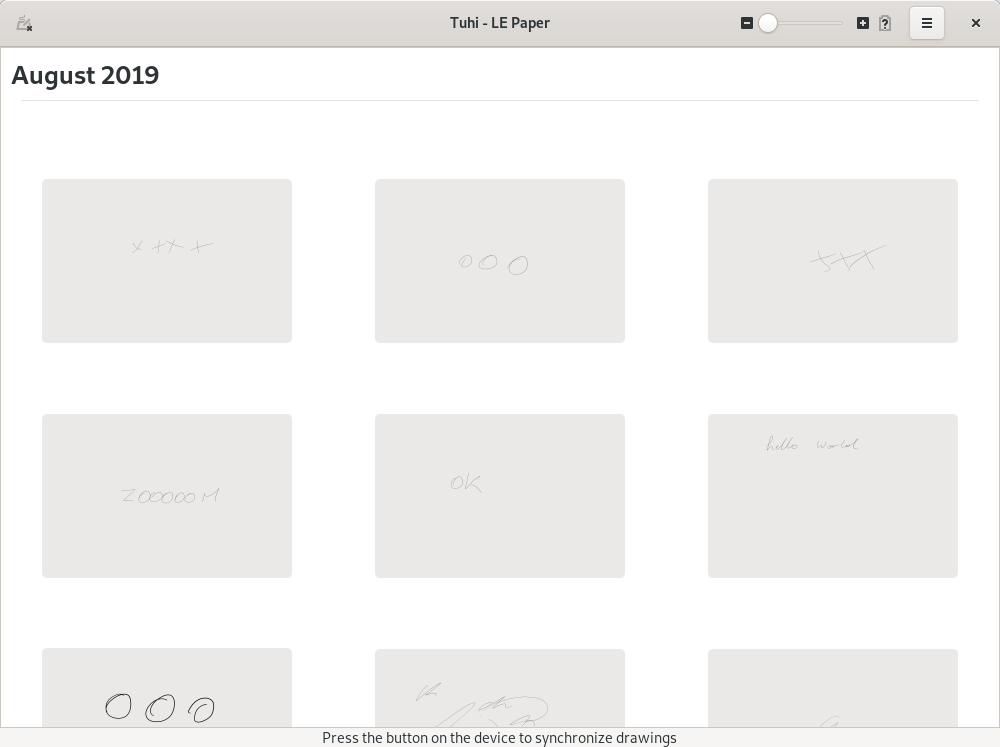
18 months ago, Benjamin Tissoires and I wrote Tuhi as a DBus session daemon. Tuhi would download the drawings from the file and make them available as JSON files over DBus to be converted to SVG or some other format by ... "clients". We wrote a simple commandline tool to debug Tuhi but no GUI, largely in the hope that maybe someone would be interested in doing that. Fast forward to now and that hasn't happened but I had some spare cycles over the last weeks so I present to you: Tuhi 0.2, now with a GTK GUI:

It's basic but also because it shouldn't do much more than just downloading the drawings and allowing you to save them. This is not an editing UI, it's effectively a file manager for the drawings on the tablet. And since by design those drawings get deleted as you download them, there isn't even much to that (don't worry, Tuhi doesn't really delete files, you can recover almost everything).

Under the hood there were some internal changes too but I suspect they'll be boring to most. The more interesting bits are reworks so we can test the conversions a lot better now and - worst case - recover files if Tuhi crashes. It is largely reverse-engineered after all.

On that note I would like to also extend my thanks to Wacom who have provided us with some of the specs for the protocol (under NDA, we cannot share these with the community, sorry). These specs helped tremendously understanding the protocol bits that were confusing at best and unknown at worst. There are still some corners in the protocol that we don't know but for the most recent generation (i.e. Intuos Pro) we should have correct parsing of the protocol.

And many thanks to Jakub Steiner for the fancy logo.

And, as of a few minutes ago, Tuhi is available as flatpak from flathub.org. For the forseeable future is is the best way to install Tuhi.